wooden-hammer
Every parent knows that moment — your toddler grabs a plastic spoon and starts banging it on every surface in sight. That natural urge to pound, tap, and knock is not mischief. It is development in action. A wooden hammer toy channels that energy into something purposeful, and when chosen well, it becomes one of the most rewarding playthings in a young child’s collection. But with so many options lining store shelves and filling online carts, how do you pick the right one? This guide walks you through everything you need to know, from age suitability and material quality to safety checks and skill-building benefits, so your little one gets exactly what they need.
Also Read: How to Make Learning Fun with Magnetic Tiles Bahawalpur
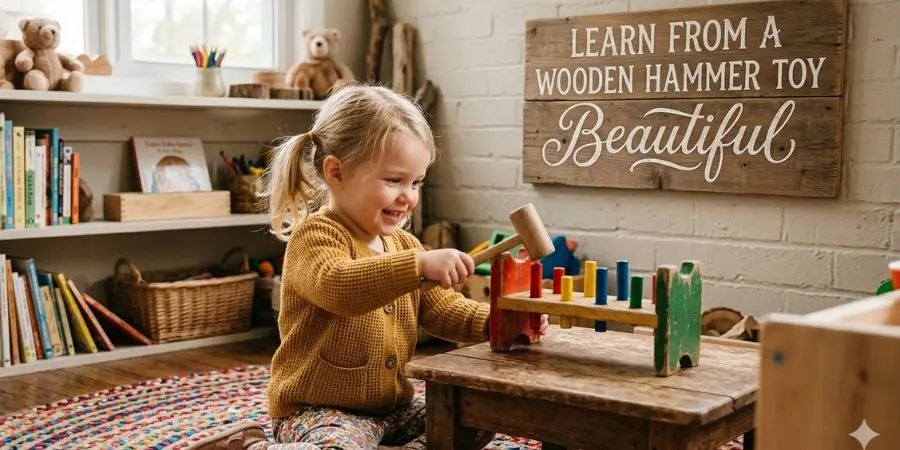
Short Answer About:What skills can kids learn from a wooden hammer toy
A wooden hammer toy helps children learn many important early development skills in a fun and hands-on way. One of the main skills it builds is hand-eye coordination, as kids learn to aim and hit objects accurately. This improves their control and focus over time. It also strengthens fine motor skills, which are important for writing, drawing, and other daily activities that require finger and hand movement.
Using a wooden hammer toy also supports problem-solving skills. Children learn how to understand cause and effect, such as what happens when they hit different objects or try different actions. It encourages thinking and exploration in a playful way.
Also Read: How a Baby Piano Helps Babies Learn Through Music and Play
Another important benefit is the development of grip strength and muscle control in small hands. This helps prepare children for school-related tasks. The toy also promotes patience and concentration because kids need to focus on their actions to achieve the desired result.
In addition, it encourages imaginative and creative play. Children can create their own games and scenarios while using the hammer, which boosts creativity and confidence. Social skills can also improve when kids play together, as they learn sharing, turn-taking, and cooperation. Overall, a wooden hammer toy is both educational and entertaining, helping children grow in multiple areas while enjoying their playtime.
Why a Wooden Hammer Toy Belongs in Every Playroom
Before diving into what to look for, it helps to understand why these toys earn such high praise from parents, pediatricians, and early childhood educators alike.
A wooden hammer toy is not just a fun object to swing around. When a child grips the handle, lines up a peg, and brings the mallet down, a whole cascade of developmental processes fires at once. Hand-eye coordination sharpens as the child learns to aim. Fine motor control develops through the grip and swing. Spatial reasoning grows as children figure out angles, force, and target size. Even emotional regulation gets a workout — frustration when the peg does not budge, satisfaction when it finally goes through, and pride when the board is cleared.
Beyond the cognitive and physical benefits, these toys are remarkably quiet compared to electronic alternatives, encourage independent play without batteries or screens, and have a durability that means they often outlast childhood altogether. Many families pass them from sibling to sibling, and some end up as nostalgic keepsakes.
The key, of course, is choosing the right one. Not every wooden hammer toy is built with the same care, and the differences between a great choice and a frustrating one come down to several specific factors.
Also Read: Best Baby Record Book in Pakistan for New Parents
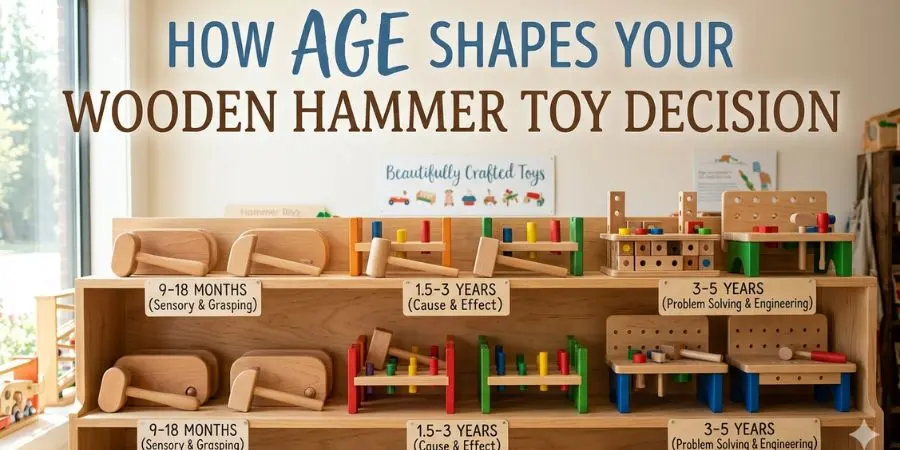
How Age Shapes Your Wooden Hammer Toy Decision
One of the most important starting points is matching the toy to your child’s developmental stage. Manufacturers print age ranges on packaging, but understanding what those ranges actually mean helps you make a smarter choice.
12 to 18 months: At this stage, children are developing the ability to intentionally strike objects. A wooden hammer toy designed for this group should have a short, chunky handle that fits comfortably in a small fist, large target pegs that are easy to hit even with imprecise swings, and a sturdy base that does not slide around under enthusiastic pounding. The focus here is purely sensory — the feel of the wood, the sound of the strike, and the visual reward of the peg moving.
18 months to 3 years: Toddlers in this range are ready for slightly more challenge. Pegs can be smaller, target holes slightly tighter, and some boards can flip over for double-sided play. Children at this age also begin to notice color, so brightly painted pegs that match colored holes introduce a basic sorting concept alongside the hammering action.
Also Read: How to Make Fun Finger Puppets at Home
3 to 5 years: Older preschoolers can handle more complex wooden hammer toy designs, including those that produce music when pegs are struck, or those that incorporate numbers and letters for early literacy and numeracy connections. The hammer handle can be longer and more slender, closer in proportion to a real tool, which also begins laying the groundwork for understanding adult work and craftsmanship.
Choosing a toy that is clearly too simple can lead to quick boredom. Choosing one that is too advanced leads to frustration. Neither outcome serves your child well, so the age window really does matter.
Materials and Finish: What Makes a Quality Wooden Hammer Toy
The word “wooden” on a label does not tell you everything. Wood quality varies enormously, and so does the finishing process. When evaluating a wooden hammer toy for purchase, pay close attention to the following.
Wood type: Solid hardwoods like beech, maple, and birch produce toys that hold up to years of enthusiastic play. These woods resist splitting and do not develop sharp splinters easily. Cheaper versions may use engineered wood, MDF, or softwoods with a thin veneer. These can look similar on the surface but crack or splinter far more readily under the repeated stress of hammering.
Also Read: What Makes a Busy Board for Toddlers a Great Educational Toy
Surface finish: Any paint or stain used on a wooden hammer toy must be non-toxic and lead-free. Look for toys that explicitly state they comply with EN71 (the European toy safety standard) or ASTM F963 (the American equivalent). Water-based, food-safe finishes are the gold standard. Avoid heavily lacquered toys that have a strong chemical smell when opened — that odor is a signal worth heeding.
Smoothness: Run your hand over every surface, including the underside of the board and the end of the hammer handle. A well-made toy will feel uniformly smooth with no rough edges or raised grain. Rounded corners and edges are not just a design choice — they protect small hands and faces from accidental scrapes.
Joinery and assembly: If the toy is assembled from multiple parts, examine how they connect. Pegs should fit snugly into their holes without wobbling. The base should sit flat without rocking. Any screws or fasteners should be fully recessed or absent entirely. A toy that rattles or wobbles before a child has even played with it is a quality concern.
Also Read: What Are the Best Baby Toys for Different Ages in Islamabad
Safety Considerations That Should Never Be Compromised
When it comes to children’s toys, safety is not a preference — it is the baseline. A wooden hammer toy has a few specific safety considerations worth reviewing carefully.
Size and choking hazards: The individual pieces, particularly the pegs, must be large enough that they cannot fit entirely in a young child’s mouth. As a general rule, any component small enough to pass through a toilet paper roll is a choking risk for children under three. If you are buying for a toddler, inspect every removable piece with this in mind.
Weight of the mallet: A hammer that is too heavy puts stress on developing wrist and elbow joints and also increases the risk of accidental strikes to fingers, faces, or other children. The mallet head should be proportional to the handle — heavy enough to drive pegs effectively but light enough that a child can control it without strain.
Stability of the base: A board that slides across a hard floor creates a frustrating and potentially unsafe play experience. Look for toys with a non-slip base or rubberized feet. Some higher-end designs use weighted bases or suction cup feet that keep the board anchored even during energetic play.
No sharp hardware: Every nut, bolt, or screw on a wooden hammer toy should be either absent or fully recessed. Children run their hands over toys and put them in their mouths. Any exposed metal hardware that a tiny finger can catch on or a small mouth can access is a risk.
Certification marks: Trustworthy manufacturers submit their toys to independent testing and display the resulting certifications visibly. In North America, look for ASTM or CPSC compliance. In Europe, the CE mark combined with EN71 compliance is the standard. In Australia, AS/NZS 8124 applies. These marks are not guarantees of perfection, but they represent a meaningful floor of safety that unverified toys may not meet.
Also Read: What Are the Best Ways to Wear Stacking Ring
Design Features That Enhance Play Value in a Wooden Hammer Toy
Once safety and material quality are confirmed, the design details determine how much enjoyment a child actually gets from the toy over time.
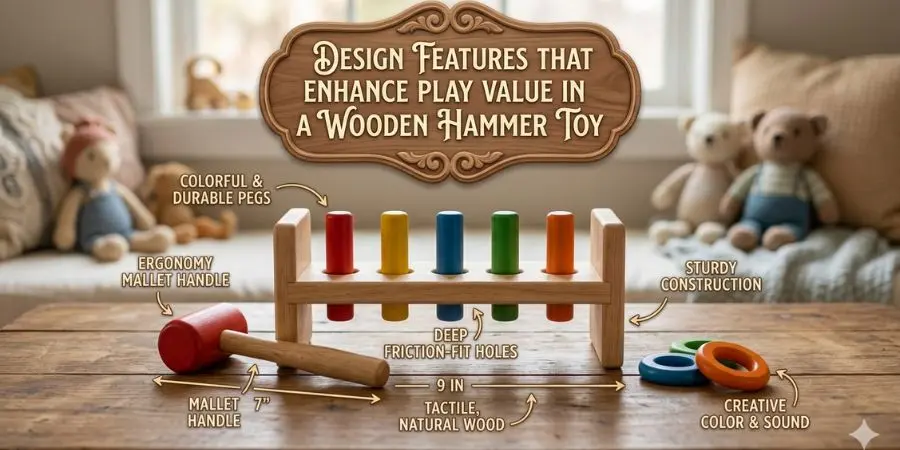
Color and visual contrast: Bright, distinct colors on pegs and corresponding holes help children make visual connections. High contrast between the peg and the board also makes targeting easier for younger children, reducing frustration and encouraging persistence.
Sound: Some wooden hammer toy designs include a xylophone-style base that produces a musical note when a peg is struck. This audio reward is highly motivating for young children and adds an extra dimension to play. If sound is a feature, check that the notes are pleasant — some budget versions produce tinny, harsh tones that become grating quickly.
Reversibility: Double-sided boards offer extended play value. One side might feature standard cylindrical pegs for basic hammering practice, while the reverse offers a different pattern or challenge. This design choice stretches the toy’s useful life significantly.
Also Read: How to Use Baby Flash Cards for 0-6 Months
Peg variety: A mix of peg sizes, shapes, or colors invites children to sort before they hammer — a simple extension of the toy’s core function that adds a cognitive layer without any additional complexity.
Portability: A compact wooden hammer toy that fits in a bag is ideal for travel, waiting rooms, and visits to grandparents’ homes. Some designs include a carrying handle or a storage compartment in the base for the pegs, which is both practical and teaches children a sense of order and ownership.
Top Styles of Wooden Hammer Toy Available Today
The market has evolved considerably, and the classic peg-and-board design now has several distinct variations worth knowing about.
Also Read: Baby Books Pakistan for Brain Development & Creativity
The classic peg bench: This is the original — a flat or slightly elevated board with pre-drilled holes and a set of cylindrical or mushroom-shaped pegs. It remains the most popular style and the one most developmental experts reference when discussing the benefits of hammering toys. It is simple, durable, and appropriate for the widest age range.
The musical xylophone bench: A variation that combines the peg bench with a xylophone base. Striking different pegs produces different notes, and some children become genuinely absorbed in the musical experimentation this allows. The added musical element increases the toy’s lifespan as children grow from basic hammering into early musical exploration.
The shape-sorting hammer board: This design replaces or supplements cylindrical pegs with shaped blocks — stars, circles, triangles, squares — that fit into corresponding holes. The child must identify the correct shape, orient it properly, and then hammer it through. This version is ideal for children aged two and a half and older, where it adds a strong cognitive challenge to the physical activity.
The ball track hammer toy: Rather than pegs and holes, this design features a ball run. The child hammers a ball through a series of tracks or channels, watching it travel and gather speed. This style tends to be more engaging for children who have outgrown the basic peg bench but still enjoy the hammering action.
The workbench set: For children four and older, miniature workbench sets incorporate a wooden hammer toy alongside toy saws, wrenches, and screwdrivers. These encourage imaginative role play and a broader engagement with the concept of building and making, which is particularly rewarding for children who watch adults doing handiwork.
What to Expect to Spend on a Wooden Hammer Toy
Price ranges for wooden hammer toys span a wider spectrum than many parents expect. Understanding what drives cost helps you spend wisely.
At the lower end, between ten and twenty dollars, you will find basic peg benches that are functional but may use softer woods, thinner paint coatings, and lighter-weight construction. These are not necessarily unsafe, but they tend to show wear more quickly and may not survive multiple children or years of use.
The mid-range, between twenty and fifty dollars, covers well-constructed toys from reputable manufacturers. In this range, you are likely to find hardwood construction, certified non-toxic finishes, thoughtful design details, and meaningful quality control. For most families, this is the sweet spot.
Premium options above fifty dollars include heirloom-quality pieces made from sustainably sourced hardwoods, finished by hand, and designed to last decades. Brands like Hape, Melissa & Doug, Grimm’s, and PlanToys operate in this space. These are excellent choices for gifts or for families who prefer buying fewer, higher-quality objects.
Final Thoughts
Choosing a wooden hammer toy is one of those parenting decisions that feels small but pays dividends for years. The right toy meets your child where they are developmentally, grows with them as their skills advance, and stands up to the inevitable enthusiasm of repeated daily use.
Start with safety — certified materials, appropriate peg sizes, and a stable base. Then consider quality — hardwood construction, smooth finishes, and solid joinery. Finally, think about design features that match your child’s current interests and abilities while leaving room for them to grow into greater complexity.
A wooden hammer toy does not need to be flashy or expensive to be excellent. It needs to be safe, durable, and genuinely engaging for the child who will use it. When all three of those qualities come together, you end up with something rare in the world of children’s toys: an object that earns its place in the playroom not just for a season, but for years.
Trust your instincts, do your research, and when in doubt, choose quality over price. Your child — and their developing hands, eyes, and mind — will thank you for it.
FAQs
What age is best for a wooden hammer toy?
Most wooden hammer toys suit children from 12 months onward. Match the complexity to your child’s stage — simple large pegs for toddlers, shape-sorting designs for ages 3 and up.
Are wooden hammer toys safe for toddlers?
Yes, when certified. Look for ASTM or EN71 compliance, non-toxic paint, smooth edges, and pegs too large to swallow. Always supervise children under three during play.
What wood type is best for a wooden hammer toy?
Hardwoods like beech, maple, and birch are ideal. They resist splitting and splintering far better than softwoods or engineered wood under repeated hammering stress.
How much should I spend on a wooden hammer toy?
Mid-range ($20–$50) offers the best value — solid hardwood, certified finishes, and lasting durability. Budget options wear faster; premium picks above $50 are true heirlooms.
What skills does a wooden hammer toy build in children?
It develops hand-eye coordination, fine motor control, spatial reasoning, and emotional regulation — all through the simple, satisfying action of hammering pegs into a board.

“Hi, I’m Turab Sheikh, the founder of Kids Play Learn. With 2+ years of experience in creating safe and educational toys, I’m passionate about helping children learn, play, and grow in a fun way every day, and I focus on providing toys that inspire creativity, curiosity, and joyful learning.”