pop-up-toys
There is something almost magical about a toy that surprises a child. One moment everything is still, and the next a colorful figure springs into the air, drawing a gasp of delight from a tiny face. Pop up toys have been doing exactly that for generations, and yet their appeal never fades. Parents reach for them instinctively, pediatric therapists recommend them confidently, and children return to them again and again long after flashier gadgets have lost their charm.
But what exactly is happening during those moments of play? What is going on in a child’s mind when a lid pops open or a button sends a creature flying upward? The answer turns out to be far richer than most people expect. Pop up toys are not simply entertaining diversions. They are carefully designed learning tools that touch nearly every dimension of early childhood development — physical, cognitive, emotional, and social. Understanding why they work so well helps parents choose them more intentionally and get even more out of playtime.
Also Read: How to Make Learning Fun with Magnetic Tiles Bahawalpur
Short Answer About: What age are pop up toys suitable for
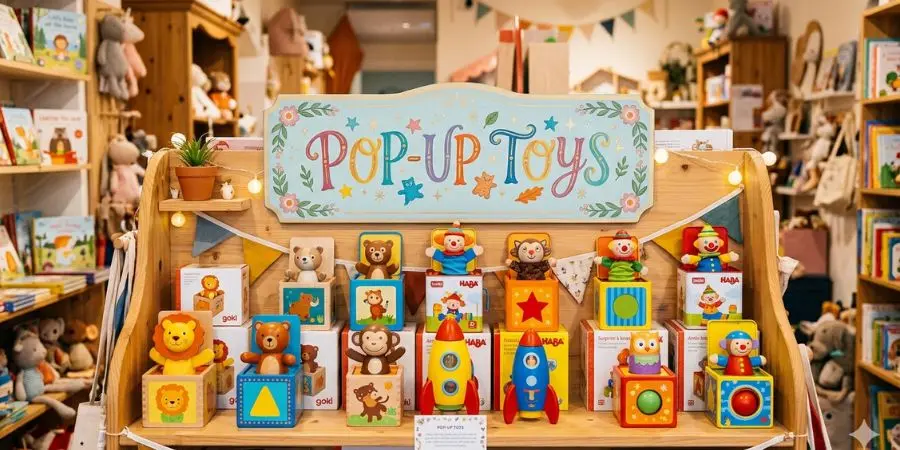
Pop up toys are generally suitable for children between 12 months and 3 years of age, although some models can be enjoyed by older toddlers as well. Around their first birthday, many children begin exploring toys that respond to their actions. Pop up toys are perfect for this stage because they allow little hands to press buttons, flip switches, turn knobs, or slide levers to make characters appear.
These simple activities help toddlers understand cause and effect while keeping them entertained. As children grow, they become more interested in figuring out how each mechanism works, which supports problem-solving and critical thinking skills. The bright colors, moving parts, and playful surprises also help hold their attention during playtime.
When choosing a pop up toy, it is important to check the manufacturer’s recommended age range. Toys designed for younger children should have smooth edges, durable materials, and pieces that are large enough to prevent choking hazards.
Also Read: How a Baby Piano Helps Babies Learn Through Music and Play
Every child develops at a different pace, so the best age for a pop up toy depends on the child’s interests and abilities. In general, these toys are an excellent choice for toddlers who are learning to explore, discover, and develop important early motor skills through hands-on play.
How Pop Up Toys Support Sensory Development in Young Children
Before a child can think in words, the world arrives through the senses. Everything a baby or toddler encounters is first processed as texture, sound, color, weight, and movement. Pop up toys are built for exactly this stage of life.
Most pop up toys combine multiple sensory inputs at once. The bold, contrasting colors that manufacturers favor are not accidental — they are chosen because young eyes are still developing the ability to distinguish subtle shades, and high-contrast visuals grab and hold attention most effectively. When a figure springs upward, the sudden movement provides a visual jolt that trains the developing visual tracking system. Eyes must quickly follow a moving object, a skill that will later support reading, catching a ball, and tracking lines of text across a page.
Also Read: Best Baby Record Book in Pakistan for New Parents
Then there is sound. Many pop up toys are designed with a satisfying click, squeak, or pop that accompanies the visual event. This combination of simultaneous sensory inputs — the sight of movement paired with the sound of action — creates what developmental specialists call a multisensory learning moment. The brain is not just receiving one stream of information; it is learning to connect different types of input into a single, unified experience. That connection-building is foundational to how children eventually interpret the world.
Touch matters too. The buttons, levers, and lids on pop up toys vary in resistance, shape, and texture. A chunky circular button feels and operates differently from a sliding tab or a twist-and-turn mechanism. Fingers learn to apply different kinds of pressure, different angles, and different motions. This variety keeps sensory exploration active rather than passive, turning every play session into a rich tactile lesson.
Also Read: How to Make Fun Finger Puppets at Home
The Role of Pop Up Toys in Building Fine Motor Skills
Watch a toddler work through a pop up toy with multiple mechanisms, and you are watching a serious workout for the small muscles of the hands and fingers. Fine motor development is one of the most critical physical milestones of early childhood, yet it requires consistent, motivated practice. Pop up toys provide exactly that motivation.
The range of actions required across different pop up toy designs covers nearly every fine motor challenge a young child needs to master. Pressing a button requires isolated finger strength and control.
Turning a dial builds the rotational wrist motion that children will later use for writing and self-care tasks like opening jars or turning door handles. Sliding a lever demands a pinching grip similar to the one used with pencils and scissors. Lifting a small lid requires thumb-finger coordination that supports countless daily activities.
What makes these demands effective rather than frustrating is the immediate reward. The cause-and-effect relationship built into every pop up toy means that successful motor execution produces instant, satisfying feedback.
A child who presses the right button at the right angle gets the pop. That reward loop keeps children trying, refining their movements, and trying again. Repetition is the engine of motor learning, and pop up toys make repetition feel like a game rather than a chore.
Occupational therapists frequently use pop up toys in their work with children who have developmental delays, motor coordination challenges, or sensory processing differences. The controlled challenges these toys offer allow therapists to target specific skills in a context that feels natural and enjoyable to the child. The same benefits exist for typically developing children at home — the therapy table and the living room floor are not as different as they might seem when the toy is doing its job well.
Also Read: What Makes a Busy Board for Toddlers a Great Educational Toy
Why Pop Up Toys Are Perfect for Teaching Cause and Effect
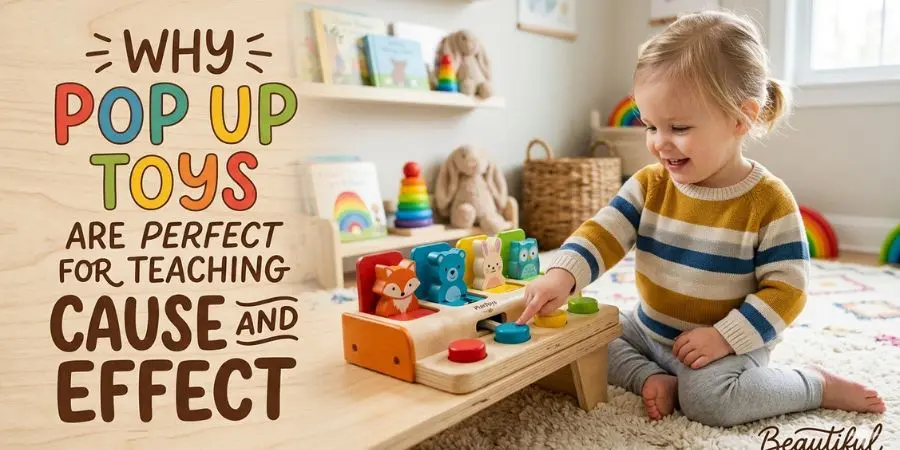
Cause and effect is one of the earliest and most important intellectual concepts a child will ever grasp. It is the beginning of logical thinking, problem-solving, and scientific reasoning. Long before children can articulate the principle, they begin to understand it through direct physical experience — and few experiences teach it more clearly than a pop up toy.
The mechanism is elegantly simple. A child performs an action. Something happens as a direct result. The connection is unmistakable, immediate, and repeatable. Press this — that pops up. Push this lever — this creature appears. Twist this knob — that lid opens. Every interaction is a tiny experiment with a clear outcome.
What researchers find particularly interesting is how children test this understanding. Once a child has seen what a button does, they do not simply accept it and move on. They press it again. And again. They press it slowly, then quickly. They press it with one finger, then two. They are not being repetitive for the sake of habit — they are running experiments.
They are checking whether the outcome is consistent, whether it depends on how they act, and whether they can predict what happens next. This is the earliest form of scientific thinking, happening naturally in a child who is probably still in diapers.
Pop up toys also introduce children to the idea that different causes produce different effects. A toy with four separate compartments, each opened by a different mechanism, teaches children that the world is varied and nuanced — that not all problems are solved the same way. This flexibility of thinking, applied early, becomes a powerful cognitive asset as children grow.
Also Read: What Are the Best Baby Toys for Different Ages in Islamabad
How Pop Up Toys Encourage Cognitive Growth and Memory
Beyond cause and effect, pop up toys actively engage and develop memory, attention, and pattern recognition — three cognitive capacities that sit at the heart of academic learning.
Memory development begins with the very first time a child masters a mechanism. Having figured out how to make the blue compartment open, a child stores that knowledge. When they return to the toy an hour later or the next day, they access that stored knowledge and apply it. This process of encoding, storing, and retrieving information — even in its simplest form — is memory in action. Pop up toys give children something worth remembering and a reason to remember it.
Attention is trained each time a child works through a challenge that requires sustained focus. The moment before the pop is a moment of anticipation, and anticipation requires holding attention steady. Children learn to concentrate not just during the action but in the buildup toward it. Over time, this capacity to sustain attention without immediate reward grows — a capacity that will matter enormously when children sit in classrooms and listen to teachers or work through problems that take time to resolve.
Pattern recognition emerges as children notice that certain types of actions tend to produce certain types of results. Round buttons often push straight down. Sliding pieces move along tracks. Lids swing open on hinges. Without anyone teaching them explicitly, children begin to categorize mechanisms and form expectations. They bring these pattern-based predictions to new pop up toys and to new situations beyond the toy box.
Also Read: What Are the Best Ways to Wear Stacking Ring
Pop Up Toys and the Development of Emotional Regulation
One aspect of pop up toys that parents notice but rarely articulate is their role in helping children manage emotions — specifically the emotions that arise when something does not work the way a child expects.
Young children experience frustration intensely. When a mechanism resists, when a button does not respond, when a lid will not open, the temptation is to cry, throw the toy, or give up entirely. Pop up toys with age-appropriate challenges create exactly these moments of mild frustration in a safe, low-stakes context. The toy does not judge. There is no audience. And crucially, there is a solution available — the child simply has not found it yet.
Also Read: How to Use Baby Flash Cards for 0-6 Months
Working through that frustration, trying a different approach, and eventually succeeding is a process that builds emotional resilience. Children learn in their bodies, through repeated experience, that frustration is not a signal to quit — it is a signal to try differently. That lesson, absorbed through dozens of small playtime moments, becomes a disposition. Children who have practiced working through challenge develop a higher tolerance for difficulty and a stronger belief in their own ability to figure things out.
The moment of success is equally important emotionally. The pop, the squeak, the bouncing figure — these are rewards that feel genuinely earned. The joy children show is not just pleasure at the sensory event. It is the satisfaction of mastery. Cultivating that satisfaction, linking it to effort and persistence, is one of the most valuable things a toy can do for a developing child.
Social and Language Benefits of Playing with Pop Up Toys
Pop up toys are often thought of as solo activities, but some of their richest developmental benefits emerge in shared play. When a caregiver sits alongside a child with a pop up toy, the interaction becomes a scaffold for language, communication, and social understanding.
Consider what happens naturally in that situation. A parent points and says, “Look — push that one!” The child hears a directive, sees a gesture, and connects it to an action. When the figure pops up, the parent says, “It worked! Up it goes!” The child hears vocabulary — push, up, look, works — attached to visible, physical events. This is how early language acquisition actually happens, not through drills but through words embedded in meaningful, shared experiences.
Questions from caregivers extend the learning further. “Which one should we try next?” prompts decision-making and turn-taking. “What do you think will happen?” builds predictive thinking and encourages children to express their ideas. “Your turn — can you do it?” transfers agency to the child and signals trust in their capability.
Also Read: Baby Books Pakistan for Brain Development & Creativity
Group play among children of similar ages introduces additional social dynamics. Waiting for a turn, watching a peer figure something out, celebrating someone else’s success — these are prosocial skills that begin to develop surprisingly early. A shared pop up toy becomes a shared experience, and shared experience is the foundation of genuine social connection.
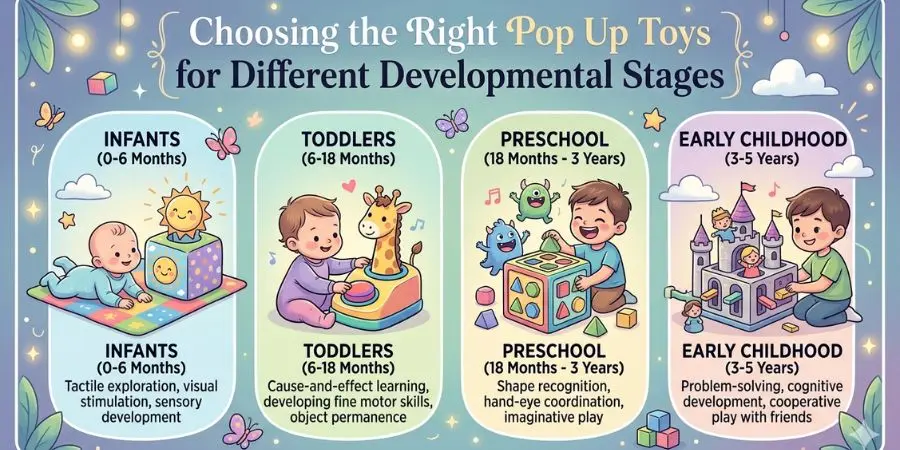
Choosing the Right Pop Up Toys for Different Developmental Stages
Not every pop up toy is right for every age, and matching the toy to the child’s current developmental stage makes a significant difference in how much learning actually takes place.
For the youngest babies, from birth to around six months, pop up toys work best as passive visual experiences. Bright, high-contrast versions that an adult can operate while the baby watches are ideal at this stage. The goal is visual tracking and auditory engagement, not physical interaction.
Between six and twelve months, as babies develop reaching, grasping, and batting movements, simpler pop up mechanisms become appropriate. Large, easy-to-press surfaces that require minimal precision allow babies to experience the cause-and-effect relationship without the frustration of mechanisms that demand more dexterity than they yet possess.
Toddlers between twelve and thirty-six months are ready for the classic jack-in-the-box style pop up toy as well as activity cubes with multiple different mechanisms. At this stage, the variety of challenges is part of the benefit. Children are developing rapidly and need toys that grow with them over this period — a toy with four or five different mechanisms can remain engaging and appropriately challenging for many months.
Preschool-aged children, from about three to five years, benefit from pop up toys that introduce more complexity — mechanisms that require two steps, shapes that must be matched before a compartment opens, or sequences that must be completed in order. These added layers of challenge align with the growing cognitive capacity of this age group and continue to push development forward.
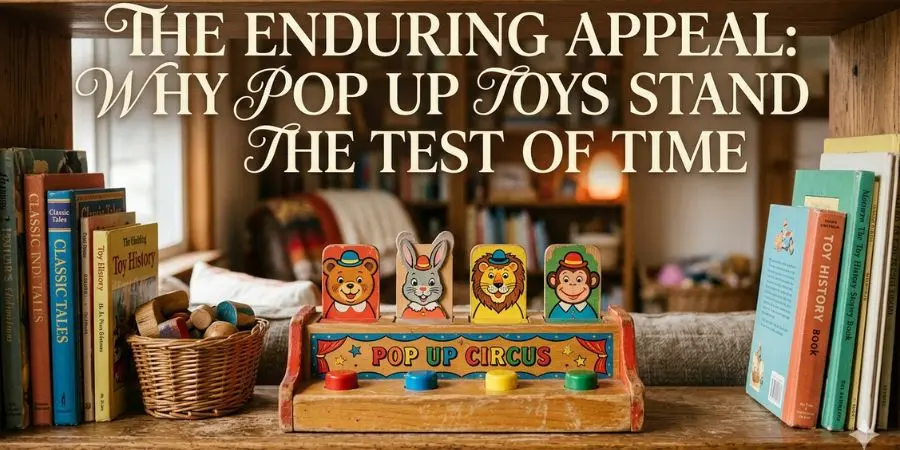
The Enduring Appeal: Why Pop Up Toys Stand the Test of Time
In an era when children’s toys are increasingly digital, screen-based, and automated, pop up toys represent something genuinely different. They do not require batteries. They do not produce sounds unless a child makes them do so. They do not animate themselves or reward passive watching. Every single thing that happens with a pop up toy happens because a child made it happen.
This fundamental quality — that the child is always the agent — is exactly what makes pop up toys irreplaceable in early learning. Digital toys, however sophisticated, tend to position children as audiences or passengers. Pop up toys position them as drivers. The child’s hands, the child’s thinking, the child’s persistence — these are what make the toy work. And when it does work, the credit belongs entirely to the child.
That experience of genuine agency is not a small thing. It shapes how children see themselves in relation to challenges. A child who has spent hundreds of hours making things happen with their own hands develops a fundamentally different relationship with difficulty than a child who has spent hundreds of hours watching screens respond to their passive presence. The first child expects to be able to figure things out. The second child expects things to happen automatically.
Pop up toys also demand and reward presence. There is no multitasking with a pop up toy. A child must be fully engaged — watching, feeling, adjusting, trying. That quality of total engagement is itself a kind of practice, a training of the attention that becomes increasingly rare and increasingly valuable in a distracted world.
Final Thoughts
The case for pop up toys in early childhood is not built on nostalgia, though there is certainly warmth in seeing a toy that has delighted children across generations continue to do so today. It is built on what we understand about how young children actually learn — through their bodies, through repetition, through sensory experience, through challenge, and through the profound satisfaction of making something happen on their own.
Pop up toys deliver all of this in a package that is simple, durable, affordable, and endlessly engaging. They develop fine motor skills through varied, motivated practice. They teach cause and effect through direct, repeatable experience. They build cognitive capacity through memory, pattern recognition, and problem-solving. They support emotional resilience through the experience of working through frustration toward mastery. And they create natural opportunities for language, connection, and shared joy between children and the adults who love them.
In a world of complicated choices about children’s media, screen time, and developmental toys, pop up toys offer something beautifully uncomplicated: a child, a toy, and the simple power of figuring things out. That has always been enough. It still is.
FAQs
At what age should I introduce pop up toys to my child?
You can start as early as newborn — just let them watch. By 6 months, babies can begin pressing large buttons. Toddlers aged 1–3 enjoy multi-mechanism versions most.
Do pop up toys actually help with writing skills later on?
Yes. Pressing buttons, turning dials, and sliding levers strengthen the same small hand muscles children use for holding pencils and scissors in school.
How long should a child play with a pop up toy each day?
There’s no strict limit. Short sessions of 10–15 minutes work well for babies. Toddlers can play longer naturally. Follow the child’s interest — never force it.
Are pop up toys safe for children who mouth everything?
Choose toys labeled non-toxic with no small detachable parts. Always check the recommended age on the packaging and inspect regularly for cracks or loose pieces.
Can pop up toys help children who have developmental delays?
Absolutely. Occupational therapists regularly use them to build motor control and cause-effect understanding. Always consult your child’s therapist for guidance on the best type.

“Hi, I’m Turab Sheikh, the founder of Kids Play Learn. With 2+ years of experience in creating safe and educational toys, I’m passionate about helping children learn, play, and grow in a fun way every day, and I focus on providing toys that inspire creativity, curiosity, and joyful learning.”