Baby Piano Helps Babies Learn, There is something deeply magical about watching a baby press a key on a tiny piano for the very first time. The moment that sound rings out — bright, clear, and unexpected — you can see it on their face. Eyes go wide. Hands freeze mid-air for a split second. Then comes the grin, and the immediate reach for another key. It happens almost every time, with almost every baby, and it never gets old for the parents watching.
That reaction is not just cute. It is actually one of the earliest signs that something meaningful is happening inside that small, rapidly developing brain. A baby piano is not simply a toy. It is, in many ways, one of the most powerful learning tools you can give a child in their first few years of life. And the reasons why go much deeper than most parents initially expect.
Also Read: Baby Books Pakistan for Brain Development & Creativity
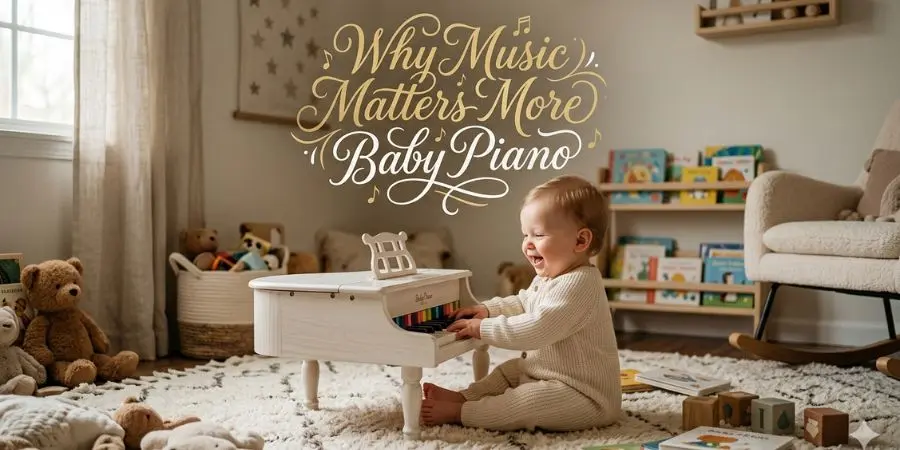
Short Answer About: Why Music Matters More Baby Piano
Music plays an important role in a baby’s early growth, and a baby piano is one of the simplest ways to introduce it. When babies press the keys and hear different sounds, they begin to understand cause and effect. This small action helps them learn that their movements can create something enjoyable and meaningful.
Baby Piano Helps Babies Learn, A baby piano also supports the development of listening skills. Babies learn to recognize different tones, rhythms, and patterns, which can strengthen their attention and memory over time. Musical play encourages curiosity and keeps little minds engaged in a positive activity.
Another benefit is physical development. Reaching for keys, pressing buttons, and exploring different features help improve hand and finger coordination. These movements contribute to the development of fine motor skills that children will use later for writing, drawing, and other everyday tasks.
Also Read: How to Make Fun Finger Puppets at Home
Music can also create happy moments between parents and children. Singing along, clapping, and playing together helps build a strong bond while making learning feel natural and fun.
Baby Piano Helps Babies Learn, Most importantly, a baby piano allows children to express themselves freely. There are no rules or expectations—just exploration and discovery. Through music, babies can develop confidence, creativity, and a love for learning that can continue as they grow.
Why Music Matters More Than We Realize in the Early Years
Before we talk about the instrument itself, it is worth stepping back and appreciating what music actually does to a developing brain. Infants are born into a world of noise. They hear voices, traffic, the hum of appliances, and the creak of floorboards. Baby Piano Helps Babies Learn, But music is different. Music has structure. It has pattern, rhythm, repetition, and emotion woven into every note. And a baby’s brain, which is building neural connections at an almost incomprehensible rate during those first years, responds to structure in a profound way.
Research has consistently shown that early musical exposure influences multiple areas of development simultaneously. Language development, emotional regulation, spatial reasoning, social bonding — all of these are shaped, in part
By how much and how meaningfully a child engages with music in their early years. When a baby interacts with a piano — not just hearing music passively, but physically producing it with their own hands — the effect is amplified many times over. They are not just listening. They are doing, discovering, and making sense of cause and effect all at once.
Also Read: What Are the Best Ways to Wear Stacking Ring
The Cause and Effect Lesson Hidden in Every Key
One of the most foundational cognitive lessons a baby can learn is that their actions produce results. This is the basis of agency — the understanding that “I did something, and something happened because of me.” It sounds simple, but it forms the root of confidence, curiosity, and problem-solving ability.
A baby piano teaches this lesson beautifully and immediately. Press a key, hear a sound. Press it harder, the sound is louder. Press a different key, a different sound comes out. There is no delay between the action and the result, no complicated sequence to follow, no instruction required. The feedback is instant and unmistakable.
Baby Piano Helps Babies Learn, In child development, this kind of immediate cause-and-effect interaction is considered tremendously valuable. It teaches babies that the world responds to them. That they have the power to make something happen. That exploration is rewarded. These lessons, absorbed in the first year and a half of life, quietly shape how boldly a child goes on to approach new challenges long after babyhood is over.
How Listening Skills Develop Through Musical Play
We tend to think of listening as a passive activity, something that just happens when sound reaches the ears. But genuine listening — the kind that processes, distinguishes, and responds — is a skill that has to be developed. And babies who spend time with musical instruments, especially ones they control themselves, tend to develop it much more readily.
Also Read: How to Use Baby Flash Cards for 0-6 Months
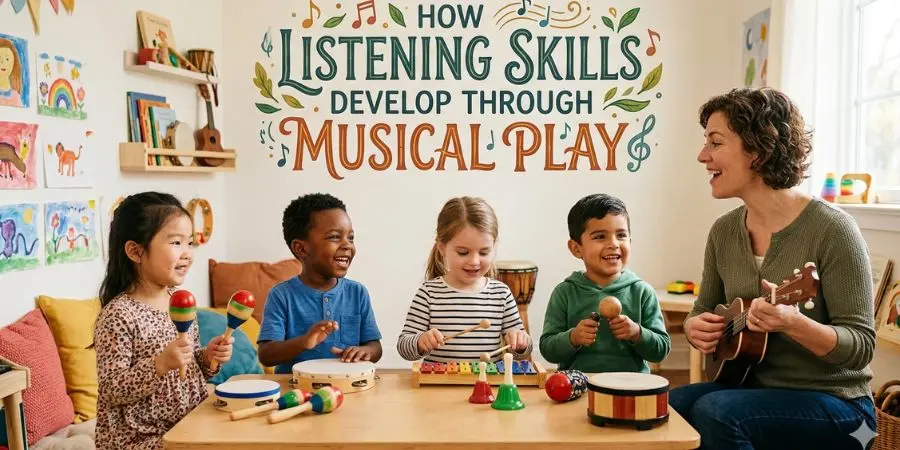
When a baby plays a piano, even in the randomest, most enthusiastic way imaginable, they start doing something interesting almost without realizing it. They begin to notice differences. This key sounds higher than that one. That sound lasted longer.
The notes they played a moment ago made something different from what they are playing now. These distinctions, picked up and processed over and over again through play, are sharpening the auditory discrimination skills that will eventually help them understand language, learn to read, and pick up new sounds in foreign languages with more ease.
Baby Piano Helps Babies Learn, Pediatric audiologists and early childhood educators have long pointed to music as one of the best natural training grounds for the listening brain. The baby piano puts that training directly in the baby’s hands — literally.
Also Read: What Materials Are Best for Baby Blocks Toys
Language Development: The Surprising Connection
This one catches a lot of parents off guard. What does a piano have to do with learning to talk?
More than you might think.
Language and music share a surprisingly large amount of neurological real estate. Both involve processing sequences of sound. Both involve rhythm and timing. Baby Piano Helps Babies Learn, Both require the brain to hold a pattern in short-term memory while anticipating what comes next.
When babies engage repeatedly with music — and especially when they make music themselves — they are exercising precisely the neural pathways that will later be used for language.
Singing to your baby while they play their little piano compounds the effect. You become a model for how sound, expression, and meaning connect. You are showing them, without saying a word about it, that sound can carry feeling, that voices and instruments can say things that ordinary speech cannot.
Babies who grow up in musically rich environments tend to babble more expressively, reach language milestones with greater confidence, and develop larger early vocabularies. The piano, humble as it might look sitting in the corner of the playroom, is doing part of that work.
Fine Motor Skills: The Physical Side of Musical Learning
Here is something practical and immediately visible: playing a piano is genuinely good exercise for a baby’s hands, fingers, and arms. Baby Piano Helps Babies Learn, These may not be muscles in the traditional sense, but developing fine motor control is a major developmental task in the first few years of life, and it takes practice — lots of it.
Also Read: What Are the Best Baby Toys for Different Ages in Islamabad
A baby piano provides the perfect canvas. Reaching for keys develops hand-eye coordination. Pressing individual keys, especially as babies grow toward toddlerhood and begin to use single fingers rather than whole-hand swipes, builds the kind of precise finger control that will later show up in drawing, stacking blocks, doing up buttons, and eventually writing.
Even the simple act of turning the piano to explore its sides, pressing multiple keys simultaneously, or banging on it rhythmically builds strength and control in the small muscles of the hands and wrists.
Baby Piano Helps Babies Learn, Parents sometimes worry that their baby is just “bashing” the piano and not really playing it. That is not only okay — it is actually developmentally appropriate and beneficial. The bashing is not mindless. It is exploratory. And with every enthusiastic smack of those colorful keys, tiny hands are getting stronger and more coordinated.
Emotional Expression and Self-Soothing
Babies feel enormous things. Frustration, delight, longing, excitement, overstimulation — all of these arrive in waves that they do not yet have the words to communicate. Music offers a different channel for expression, and babies seem to find it naturally and intuitively.
Watch a baby who is fussy settle when they encounter their piano and begin playing. Watch a baby who is excited about something bang out a celebratory run of notes. Watch a quiet, introspective baby pick out single keys slowly and thoughtfully, Baby Piano Helps Babies Learn, as if composing something. These behaviors are not accidental. Babies are figuring out, in their own wordless way, that music is a medium through which feelings can be expressed and sometimes even managed.
This early experience of music as an emotional outlet is genuinely important. It plants a seed that can grow into a lifelong coping tool — the ability to turn to music, to playing or listening, as a way of processing what is going on inside. Children who develop this relationship with music early tend to have more varied and sophisticated emotional regulation strategies as they grow older.
Social and Bonding Benefits: Music as a Shared Language
The baby piano is rarely played in isolation. Parents sit beside their babies and play along. Older siblings come to press keys together. Grandparents sing while the baby plays. This social dimension is not incidental — it is one of the richest gifts that musical play can offer.
Music has always been a bonding tool for humans. Long before recorded history, people sat together and made sound, and those shared experiences created connection. Baby Piano Helps Babies Learn, When a parent and baby play a piano together, something similar happens on a small, intimate scale. You take turns. You respond to each other’s sounds.
You mirror each other’s excitement. This kind of musical back-and-forth is one of the earliest forms of true conversation, a give-and-take exchange that predates words and lays down the social and emotional architecture that later conversations will be built on.
Researchers who study parent-infant interaction have noted that musical play — including shared instrument play — tends to generate some of the most sustained, attentive, and joyful engagement between caregivers and babies. Baby Piano Helps Babies Learn, The piano gives both parties something to focus on, something to contribute, and something to share.
Cognitive Development: Building the Brain’s Foundations
There is a concept in neuroscience sometimes called “neural scaffolding.” The idea is that certain early experiences build structural foundations in the brain that later, more complex learning gets anchored to. Music, and particularly the active, hands-on kind of musical engagement that a baby piano enables, is widely regarded as one of the most potent forms of this kind of scaffolding.
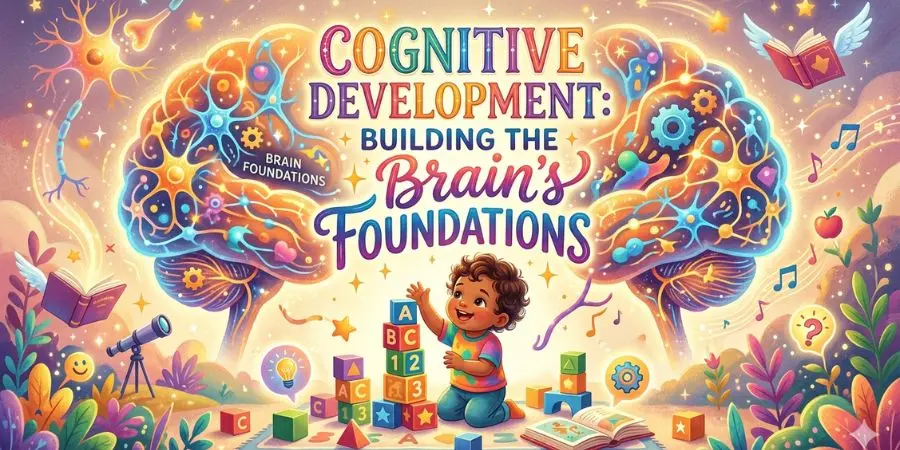
Baby Piano Helps Babies Learn, When a baby repeatedly plays the piano, they are not just learning about music. They are building memory circuits, attention pathways, pattern-recognition systems, and executive function structures.
They are learning to anticipate, to plan, to focus, and to persist. These capacities, once established, transfer. The child who developed strong pattern recognition through musical play is better equipped to recognize patterns in mathematics. The child who learned to focus through sustained musical exploration has a head start in the attention skills needed for reading.
None of this requires formal music lessons. None of it requires the baby to practice scales or sit still at a proper piano. The baby piano, played freely and joyfully, does the work on its own, simply by existing in the space where a curious baby can reach it.
Choosing the Right Baby Piano: What Actually Matters
Baby Piano Helps Babies Learn, Not all baby pianos are created equal, and it is worth thinking carefully about what to look for. The market is flooded with options, ranging from simple toy keyboards to more thoughtfully designed instruments, and the differences matter more than the price tags suggest.
Sound quality is genuinely important. Babies are training their ears every time they play, and a tinny, off-pitch instrument is actually working against the auditory development you want to encourage. Look for instruments with clear, reasonably accurate tones. They do not need to be tuned to concert pitch, but they should sound musical rather than mechanical.
Key size and spacing matter too. Baby-sized keys should be proportioned for small hands, close enough together that pressing one key at a time becomes possible as the baby’s coordination develops. Keys that are too large or too widely spaced will frustrate this development rather than support it.
Durability is practical but also safety-relevant. Babies will drop the piano, bang it against the floor, chew on the corners, and do things to it that would horrify a music teacher. Choose something that can withstand all of this without breaking into small, swallowable pieces.
Finally, consider whether the instrument grows with the child. Some baby pianos have settings, modes, or features that offer increasing complexity as the baby develops. These can extend the instrument’s useful life considerably and keep pace with a growing child’s abilities.
Integrating the Piano Into Daily Routines
A baby piano does not need its own dedicated “music time” to be effective. In fact, some of the most valuable musical learning happens when the piano is simply woven into the ordinary rhythms of the day.
Baby Piano Helps Babies Learn, Keep it accessible. A piano that lives in a toy box or gets taken out only for special occasions will be played far less than one that sits in the living room where the baby spends most of their time. Accessibility is everything. The more a baby can reach for their piano on a whim, the more they will.
Use it during transitions. The period after waking from a nap, or the restless stretch before dinner when a baby is not quite hungry but not quite content either — these are natural times for musical play. The piano provides a gentle focus and can ease a baby through those in-between moments with considerably less fussiness.
Play alongside your baby as often as you can. Even if you have no musical training whatsoever, sitting beside your baby and pressing keys together creates that vital shared experience. You do not need to know what you are doing. Your baby certainly does not. You just need to be there, engaged, curious, and enjoying it alongside them.
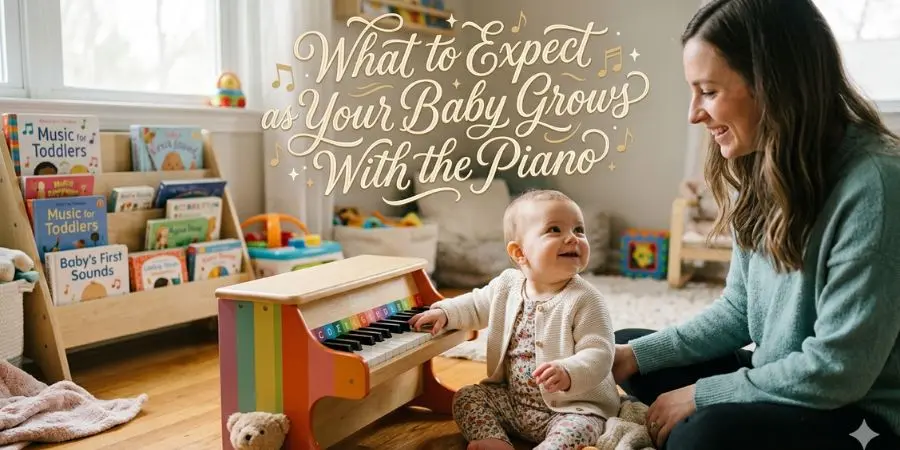
What to Expect as Your Baby Grows With the Piano
In the first few months, your baby’s interaction with the piano will likely be mostly physical — reaching for it, mouthing it, swatting at it. This is fine and good. They are beginning to build a sensory relationship with the object.
Between about six and twelve months, you will likely start to see more intentional engagement. Babies at this stage often begin to show preferences — a key they seem to like better than others, a rhythm they return to repeatedly, a particular response to a familiar sound. These preferences are worth noting and celebrating. They are evidence that your baby is not just randomly producing sound, but beginning to develop a musical sensibility.
From twelve months onward, and especially as babies become toddlers, the piano play often becomes more elaborate. You may see your toddler begin to “perform” — playing with an audience in mind, responding to your reactions, modifying what they are doing based on your expressions. This is a remarkable developmental milestone, the first stirrings of musical communication as a social act.
Final Thoughts
The baby piano is one of those objects that looks like a toy but functions as something considerably more. It is a learning tool, a communication device, a bonding instrument, and a developmental engine all wrapped up in a bright, cheerful package. The fact that it also produces sounds that parents find either charming or maddening depending on the hour is just part of the deal.
What matters, underneath all the joyful noise, is what is actually happening. A small person is discovering that their actions have consequences. They are training their ears, strengthening their hands, building language pathways, and learning — in the most organic, joyful way possible — that the world responds to them. They are making something from nothing, which is, at its core, the very beginning of creativity.
You do not need to raise a musician. You do not need to sign your baby up for any kind of formal program or follow any particular method. You just need to put a piano within reach, sit beside your child when you can, and let them play. The learning will take care of itself, one cheerful, clumsy, delightful note at a time.
FAQs
What age to introduce a baby piano?
From as early as 4–6 months — no need to wait until they seem “ready.”
Is random banging actually useful?
Yes — it builds muscles, coordination, and cause-and-effect understanding, even when it looks chaotic.
Do I need musical knowledge?
Not at all — presence and enthusiasm matter far more than skill.
How is it different from just playing recorded music?
Active participation engages the brain on multiple levels simultaneously, unlike passive listening.
Will this lead to formal music lessons?
Maybe, maybe not — but early positive experiences create openness to music that lasts, regardless of lessons.

“Hi, I’m Turab Sheikh, the founder of Kids Play Learn. With 2+ years of experience in creating safe and educational toys, I’m passionate about helping children learn, play, and grow in a fun way every day, and I focus on providing toys that inspire creativity, curiosity, and joyful learning.”