busy-board-for-toddlers
Busy Board for Toddlers, There is something almost magical about watching a toddler discover a busy board for the first time. Their eyes go wide. Their little fingers immediately reach out to touch, pull, twist, and flip every single element on it. Within seconds, they are completely absorbed — not because someone told them to play with it, but because every part of their developing brain is firing with curiosity and the joy of figuring something out.
Busy boards have been around in one form or another for decades, but in recent years they have exploded in popularity among parents, early childhood educators, and child development specialists alike. And for good reason. These simple, tactile, hands-on boards are far more than a way to keep a toddler occupied. They are genuinely powerful tools for learning, and the benefits they offer during those critical early years are hard to overstate.
So what exactly makes a busy board such a great educational toy? The answer runs deeper than most people expect.
Also Read: What Are the Best Baby Toys for Different Ages in Islamabad
Short Answer About: What Is a Busy Board, Exactly
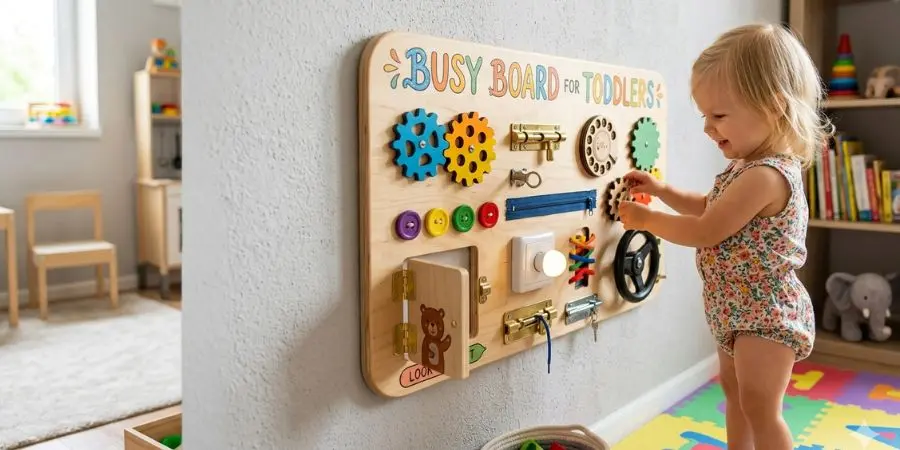
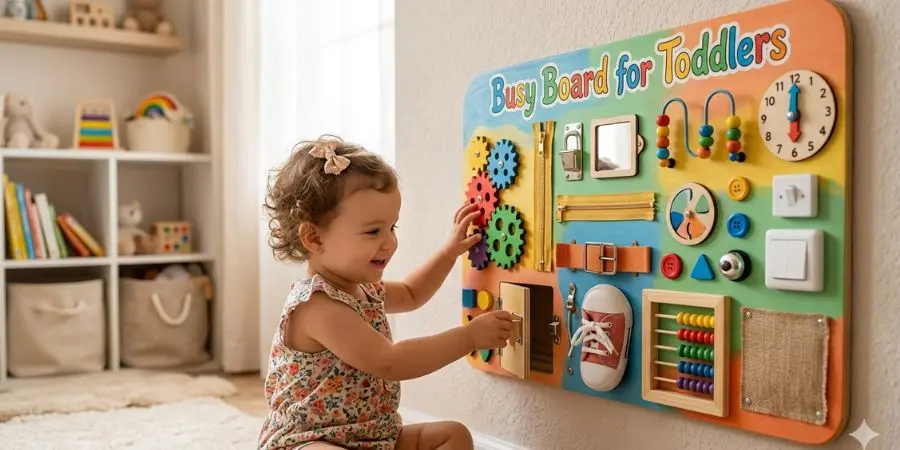
A busy board is a simple but highly engaging learning tool made especially for toddlers and young children. It is usually a flat board covered with different everyday objects that children can touch, move, and explore. Busy Board for Toddlers these items often include zippers, buttons, buckles, switches, locks, gears, laces, and small doors. The idea behind a busy board is to let children safely interact with real-life things in a controlled and fun way.
The main purpose of a busy board is to support early childhood development. While playing with it, kids naturally improve their fine motor skills as they twist, pull, push, and turn different parts. It also helps build hand-eye coordination, focus, and problem-solving skills. For example, figuring out how a lock opens or how a zipper works teaches them patience and logical thinking.
Also Read: What Materials Are Best for Baby Blocks Toys
Busy boards are also great for independent play. They keep children occupied without screens and encourage curiosity and exploration. Many parents use them during travel or quiet time because they are portable and engaging.
In short, a busy board is more than just a toy. It is a learning activity that turns everyday objects into a fun experience, helping toddlers learn essential skills while they play and discover the world around them..
Fine Motor Skills Get a Serious Workout
One of the most significant developmental tasks for children between the ages of one and four is developing fine motor control. These are the small, precise movements of the fingers, hands, and wrists that will eventually allow them to hold a pencil, button their own shirt, tie their shoelaces, use scissors, and so much more.
Fine motor development does not happen automatically. It requires repetition, challenge, and feedback. A busy board provides exactly that in a format toddlers find genuinely engaging.
When a child works to slide a bolt across its track, thread a lace through a hole, or figure out how a buckle closes, they are building the hand strength and finger coordination that underpin so many future skills. The resistance of a latch, the texture of a zipper pull, the size and shape of a button — all of these require the fingers to work in slightly different ways, and each new attempt builds on the last.
Also Read: How to Use Baby Flash Cards for 0-6 Months
What makes this particularly effective is that the learning is self-directed. The child does not sit still while an adult drills them on holding a pencil correctly. They chase their own curiosity, and in doing so, they practise the same foundational movements dozens of times without ever feeling like they are doing exercises.
Cognitive Development Through Problem-Solving
A busy board is, at its core, a collection of small puzzles. Each element presents a problem: How does this work? What happens if I push this? Why won’t this latch close?
Toddlers are natural problem-solvers. Their brains are wired to seek patterns, test hypotheses, and figure out cause and effect. A busy board gives them a structured environment where this kind of thinking happens continuously.
When a child tries to open a cabinet latch for the first time and fails, they do not give up. They try again. They try a different angle. They try pushing instead of pulling. Eventually, something clicks — sometimes literally — and that moment of success is deeply satisfying. The brain releases a small burst of reward chemicals, and the child learns something important: persistence pays off, and problems have solutions.
This kind of thinking — approaching a challenge, testing strategies, adjusting, and trying again — is the foundation of logical reasoning. It is also a preview of the scientific method, though of course no toddler thinks of it that way. They just know that it feels good to figure something out.
Over time, repeated experiences of this kind build what researchers call executive function: the ability to plan, focus attention, and manage thinking. These are skills that predict academic success and emotional wellbeing far into the future.
Also Read: What Are the Best Ways to Wear Stacking Ring
Sensory Exploration and Stimulation
Toddlers learn through their senses. Touch, in particular, is an incredibly important channel for information at this age. The brain is building its understanding of the physical world largely through what the hands can feel and discover.
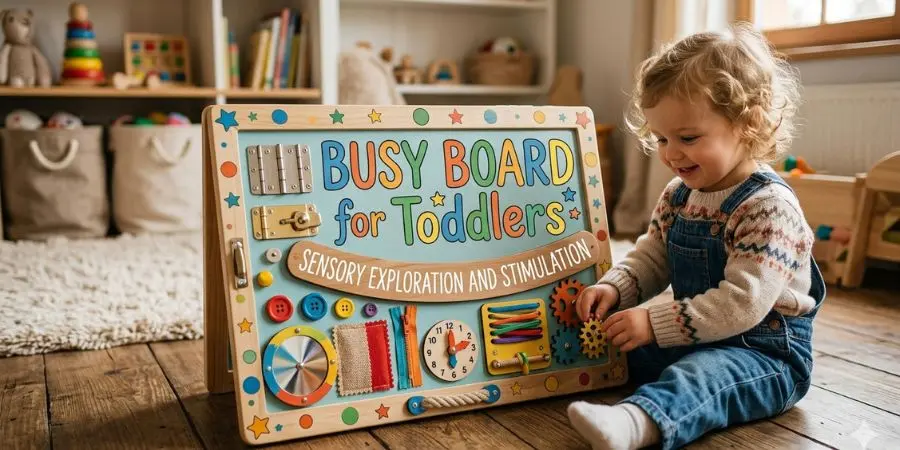
A well-designed busy board offers an enormous range of sensory input. Smooth wood next to rough fabric. The cold hardness of a metal bolt. The springy give of a velcro patch. The satisfying click of a light switch. Each of these sensations is data, and the brain is collecting and cataloguing all of it.
This kind of sensory stimulation supports neural development. Every time a child’s fingers encounter a new texture or feel the resistance of a new mechanism, new neural pathways are being formed and reinforced. The more varied and rich the sensory environment, the more the brain has to work with.
Also Read: How to Make Fun Finger Puppets at Home
For children who are particularly sensory-seeking — and many toddlers are — a busy board can also be genuinely calming. Having a dedicated space to explore and touch can satisfy that need for input in a productive way, which in turn supports better focus and emotional regulation.
Building Independence and Confidence
There is a reason toddlers are so insistent on doing things themselves. “Me do it” is practically the motto of the two-year-old. This drive toward independence is not stubbornness — it is a healthy and necessary developmental impulse. Children this age are beginning to understand themselves as separate individuals with their own capabilities, and they need repeated opportunities to test and prove those capabilities.
A busy board is beautifully suited to this need. Every element on the board is something the child can attempt on their own, figure out on their own, and succeed at on their own. There is no right or wrong way to play with it, no score to achieve, no adult telling them they are doing it wrong.
When a toddler finally manages to thread the buckle or figure out the door bolt after many tries, the look on their face is unmistakable. They are proud. They did something hard, and they did it themselves. This is not a small thing. Experiences of genuine competence — of trying something difficult and succeeding — are the building blocks of self-confidence.
Over time, children who have many such experiences develop what psychologists call self-efficacy: the belief that they are capable of tackling challenges. This belief follows them out of the playroom and into every other area of their lives.
Learning Real-World Skills Through Play
One of the things that distinguishes a busy board from many other toys is that it teaches skills that are actually useful in everyday life. The buckle on a busy board is the same mechanism as the buckle on a car seat. The zipper is the same as the zipper on a coat. The shoelaces are the same shoelaces they will eventually need to tie themselves.
This is not accidental. Many parents and makers design busy boards specifically with practical life skills in mind. The idea is that if a child has spent months practising how a zipper works in the context of play — where there is no pressure, no cold wind outside, and no need to leave the house in five minutes — they will find it much easier to apply that skill in real life when the time comes.
This transfer of learning is enormously valuable. Dressing independently, managing fasteners, understanding how household mechanisms work — these are milestones that build a child’s sense of competence and ease in the world. And it all starts with play.
Also Read: Baby Books Pakistan for Brain Development & Creativity
Concentration and Attention Span
In a world full of screens, flashing lights, and instant entertainment, sustained concentration is something many children struggle to develop. The passive experience of watching a video or following a pre-scripted game offers very little in the way of attention training.
A busy board works differently. Because the child is the one making things happen — because the activity responds to what they do and not the other way around — it requires and builds genuine focus.
Young toddlers may only spend a few minutes at a time with a busy board before moving on. But with regular play, something interesting happens: those sessions get longer. The child spends more time on each element, experimenting and persisting rather than giving up quickly. They begin to return to elements they found difficult before, motivated by the memory of partial success.
This gradual development of sustained attention is not trivial. It is practice for sitting through a story, completing a task, and eventually following along in a classroom. The muscles of attention, just like physical muscles, grow stronger with use.
Language Development Gets a Boost Too
It might not be the most obvious benefit, but busy boards are excellent platforms for language development — particularly when a caregiver plays alongside a child and narrates the experience.
“Can you push the bolt? There it goes — it slid open! Now it’s closed. Can you open it again?”
This kind of commentary, which comes naturally when a parent or educator sits with a toddler and a busy board, introduces vocabulary in context. The child hears words like “open,” “close,” “push,” “pull,” “through,” “around,” “above,” “below,” and dozens of other spatial and action words, all connected to something they are physically experiencing in real time.
Research consistently shows that vocabulary learned in the context of hands-on experience sticks far better than vocabulary learned through passive instruction. When a word is attached to a sensation, an action, and a moment of discovery, it becomes part of the child’s active language far more quickly.
Even when a child plays alone with a busy board, they often narrate quietly to themselves, practising language and reinforcing what they have heard.
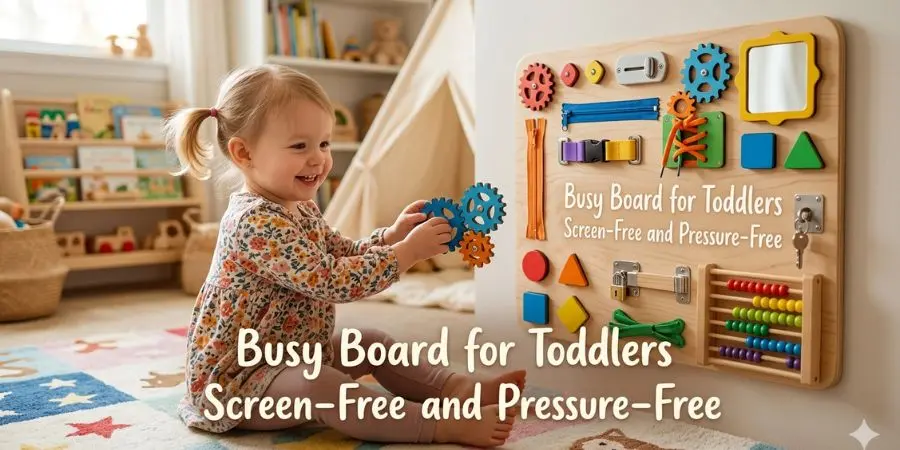
Screen-Free and Pressure-Free
In a toy market full of products that beep, flash, and demand interaction on their own terms, there is something deeply valuable about a toy that does nothing unless the child does something first. A busy board has no batteries. It does not play music unless the child happens to discover a bell attached to it. It does not reward the child with a cartoon or a jingle for pressing the right thing.
It just sits there, waiting to be explored.
This matters more than it might seem. Research into early childhood play has consistently found that open-ended toys — those without scripts or predetermined outcomes — support richer learning than toys that do all the work for the child. When a toy entertains passively, the child’s brain is in receptive mode. When a toy requires active exploration, the child’s brain is doing the work.
A busy board asks the child to bring curiosity, effort, and imagination to it. It gives them the raw materials and gets out of the way. That is a formula for genuine, lasting learning.
Adaptable Across Ages and Stages
Another practical strength of the busy board is its longevity. Unlike many toys that are outgrown quickly, a good busy board grows with the child to a meaningful extent.
A fourteen-month-old might spend all their time simply touching surfaces and looking at the mirror. An eighteen-month-old starts to engage with the mechanisms, learning what moves and what doesn’t. A two-year-old begins to figure out the sequence of a latch. A three-year-old tackles the buckle and the shoelace with genuine determination.
The same board offers different challenges at different ages because the child’s capabilities are always developing, and they naturally find the next edge of what they can do. This makes a busy board one of the better investments in a young child’s toy collection — it earns its place on the shelf for a long time.
Choosing the Right Busy Board
Not all busy boards are created equal, and it is worth thinking carefully before purchasing or making one. A few things to keep in mind:
Safety first. All elements should be securely attached with no small parts that could be pulled off and swallowed. Wood should be smooth and splinter-free. Any paint or finish should be non-toxic.
Age appropriateness. For children under eighteen months, simpler is better — large surfaces to touch, big elements to push and pull, and nothing with small pieces. Older toddlers can handle more complexity.
Variety of mechanisms. The more diverse the elements, the wider the range of skills and experiences the board supports. Try to include a mix of textures, fastener types, and moving parts.
Durability. Toddlers are not gentle. A busy board needs to be built to survive hundreds of sessions of enthusiastic play.
Many parents also choose to make their own busy boards, which allows for complete customisation. This can be a wonderful project, and there is the added bonus of being able to tailor the elements to the specific interests and developmental stage of your child.
Final Thoughts
A busy board is one of those rare toys that earns every bit of the enthusiasm it receives. It is not trendy, it is not flashy, and it does not promise to teach a child to read or count before they turn two. What it does promise — and reliably delivers — is something far more foundational: rich, hands-on, self-directed play that builds fine motor skills, problem-solving ability, sensory awareness, independence, confidence, concentration, and real-world practical knowledge.
In a world that increasingly rushes childhood and fills it with structured activities and screen time, the busy board is a reminder of what good early learning actually looks like. It looks like a small child bent over a board, tongue poking out in concentration, trying for the seventh time to slide a bolt across its track. It looks like the look on their face when they finally get it.
That moment — that pure, earned joy of figuring something out through their own effort — is what great educational toys are made of. And the busy board delivers it, again and again, every single time they sit down to play.
FAQs
What age is a busy board suitable for?
Ideal for 12 months to 4 years — younger ones explore textures, older toddlers work latches and buckles.
Can a busy board replace other educational toys?
No — it works best alongside puzzles, books, and blocks by targeting fine motor and sensory skills.
Are busy boards safe for toddlers?
Yes, when well-made. Ensure parts are firmly attached, surfaces are splinter-free, and no small pieces can be swallowed.
How long should a toddler play with one daily?
Even 10–20 minutes a day is beneficial. Let the child’s natural curiosity and attention span guide the session.
Is it better to buy or make a busy board?
Both work. Buying saves time; making one lets you customise elements to your child’s age and developmental stage.

“Hi, I’m Turab Sheikh, the founder of Kids Play Learn. With 2+ years of experience in creating safe and educational toys, I’m passionate about helping children learn, play, and grow in a fun way every day, and I focus on providing toys that inspire creativity, curiosity, and joyful learning.”