wooden-blocks-for-kids
Wooden Blocks for Kids, There is something wonderfully timeless about a set of wooden blocks sitting in the corner of a playroom. Long before tablets, apps, and battery-powered toys took over nurseries, wooden blocks were quietly doing something extraordinary — teaching children how to think, create, problem-solve, and connect with the world around them. And the fascinating thing is, decades of research and classroom observation have only confirmed what parents and educators already sensed: these simple, unassuming pieces of wood are among the most powerful learning tools a young child can have.
This article takes a deep look at how wooden blocks support early childhood development across multiple dimensions — cognitive, physical, social, emotional, and even linguistic. If you have ever wondered whether those wooden blocks collecting dust in the toy basket are actually worth keeping around, the answer is a resounding yes.
Also Read: Baby Books Pakistan for Brain Development & Creativity
Short Answer About: Wooden Blocks for Kids
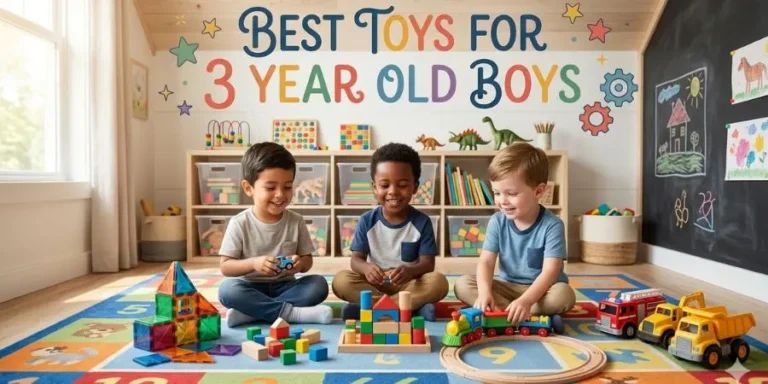
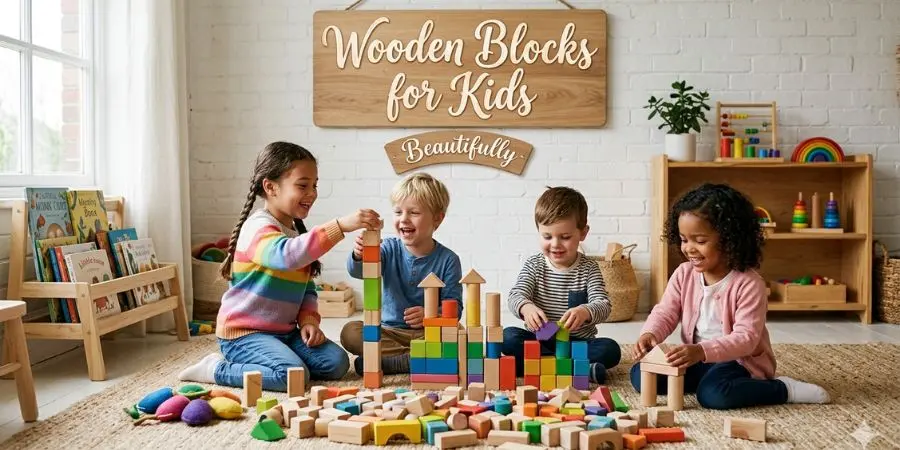
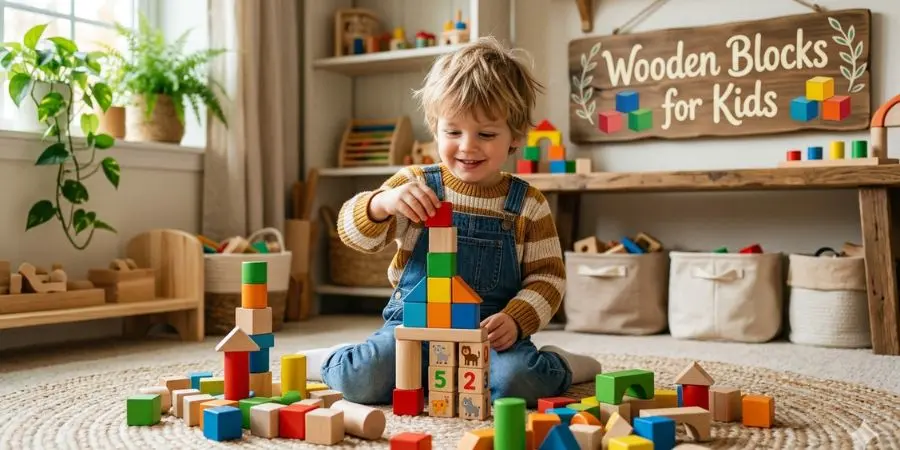
Wooden Blocks for Kids are one of the most popular and effective educational toys for early childhood learning. They are made from natural wood and designed in different shapes, sizes, and colors to attract children and encourage creative play. Wooden Blocks for Kids, These simple blocks may look basic, but they play a very important role in a child’s development.
When children play with wooden blocks, they learn how to build, stack, and balance different shapes. This helps improve their hand-eye coordination and fine motor skills. It also strengthens their thinking ability as they try to solve problems like how to make a tower stable or how to fit different pieces together. Wooden blocks also support creativity because kids can build anything they imagine, such as houses, bridges, or animals.
Another important benefit is that wooden blocks help children learn basic concepts like colors, numbers, and shapes in a fun and natural way. They also encourage social skills when kids play together, share ideas, and build structures as a team.
Overall, Wooden Blocks for Kids are a safe, long-lasting, and educational toy that supports mental, physical, and emotional growth. They are a great choice for parents who want their children to learn through fun and meaningful play.
Also Read: How to Make Fun Finger Puppets at Home
The Long History of Blocks as Educational Tools
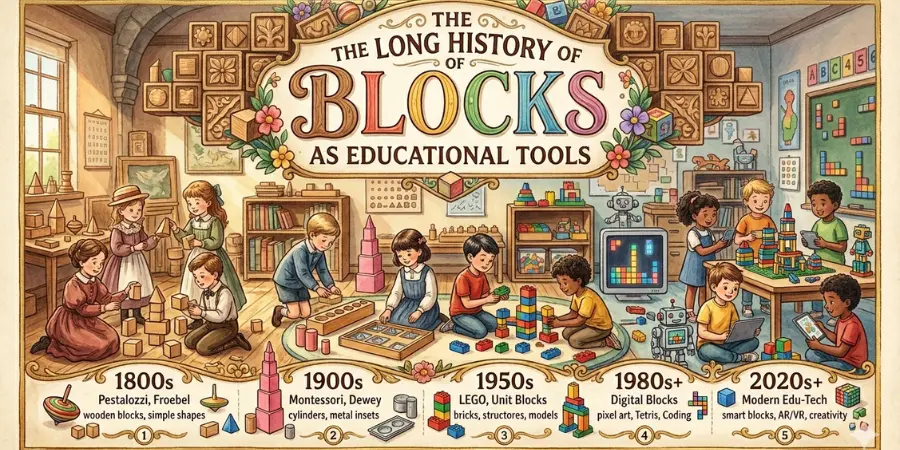
Wooden Blocks for Kids did not just appear on toy store shelves one day by chance. Their presence in early childhood education has a deliberate and well-documented history. Friedrich Froebel, the German educator who founded the concept of kindergarten in the early 1800s, designed a series of geometric wooden “gifts” — as he called them — specifically to help young children understand shape, form, and mathematical relationships through hands-on play.
His philosophy was ahead of its time. He believed that children learn through doing, not through passive listening. Froebel’s blocks were not toys in the traditional sense; they were carefully designed instruments of discovery.
That foundational idea has never really left early childhood education. From Montessori classrooms to modern preschools, you will almost always find some variation of wooden blocks because generations of educators have seen, firsthand, what they do for a child’s growing mind.
Cognitive Development: Building Brains, One Block at a Time
Wooden Blocks for Kids, When a toddler stacks a block on top of another and watches the tower wobble and fall, something more than entertainment is happening. The child is running a small experiment. They are forming a hypothesis — maybe without knowing it — and testing it. That is science in its most natural form.
Wooden block play is deeply connected to early cognitive development in several specific ways.
Spatial reasoning and geometry. Handling blocks of different shapes and sizes forces children to think spatially. They begin to understand concepts like balance, symmetry, proportion, and how shapes relate to one another. Research published in developmental psychology journals has shown that children who engage regularly with block play score higher on spatial reasoning tasks later in life — skills that are directly linked to performance in mathematics, engineering, and science.
Early mathematics. Long before a child learns to count formally, block play introduces them to foundational math concepts. Sorting blocks by size, comparing heights, grouping similar shapes, and figuring out how many small blocks equal the length of one large block — all of these are genuine mathematical experiences. Children begin to grasp concepts of more, less, equal, half, and double through physical manipulation rather than abstract numbers on a page.
Also Read: What Are the Best Ways to Wear Stacking Ring
Cause and effect thinking. Every block tower that falls teaches a child something about cause and effect. Every arch that holds up teaches them about structural integrity. These are not trivial lessons. The capacity to think in terms of “if I do this, then that will happen” is a cornerstone of logical reasoning, and block play provides hundreds of small opportunities to practice it every single session.
Attention and persistence. Completing a complex block structure — a castle, a bridge, a tall tower — requires sustained attention and a willingness to try again after failure. These qualities are not easy to teach directly, but block play naturally cultivates them because the reward of a finished structure is genuinely motivating to children.
Language and Communication: More Than Meets the Eye
It might seem strange to connect wooden blocks to language development, but the link is stronger than most people expect. When children play with blocks, they talk. They narrate what they are building, they ask questions, they negotiate with other children about what goes where, and they describe what they see.
Also Read: How to Use Baby Flash Cards for 0-6 Months
Studies have consistently found that block play sessions generate significantly more complex language than many other types of play. Children use richer vocabulary when describing spatial relationships (“the big one goes underneath,” “we need a flat piece for the roof”), and they engage in longer conversational exchanges because block structures give them something concrete to talk about together.
Parents and caregivers can amplify this benefit enormously by playing alongside children and naturally introducing new words — words like “cylindrical,” “symmetrical,” “sturdy,” “foundation,” and “horizontal.” Wooden Blocks for Kids, Children absorb vocabulary with remarkable ease when it is connected to something they are actively experiencing rather than simply being told.
Block play also supports early literacy indirectly. The storytelling that often accompanies construction play — “this is a castle and the princess lives in the tall tower” — builds narrative thinking, which is one of the cognitive foundations for reading comprehension. Children who spend a lot of time in imaginative, story-driven play tend to be better readers later, partly because they have developed strong internal narrative structures.
Fine Motor Skills and Hand-Eye Coordination
Wooden Blocks for Kids, The physical act of handling wooden blocks is a workout for small hands. Picking up a small cylindrical block with two fingers, placing it precisely on top of a narrow structure, or carefully slotting a rectangular piece into a gap — all of these actions develop fine motor skills that children will rely on for handwriting, drawing, buttoning clothes, using cutlery, and a thousand other daily tasks.
Also Read: What Materials Are Best for Baby Blocks Toys
Unlike plastic toys with large, chunky pieces designed for ease of use, good wooden blocks come in a variety of sizes and require genuine dexterity to handle. The slight weight of wood also provides tactile feedback that plastic simply does not replicate.
Children can feel the block settle into place. They can sense when a structure is unbalanced because of the resistance in their fingers. This sensory richness contributes to proprioceptive development — the body’s awareness of itself in space — which is an often-overlooked but critical dimension of physical development in early childhood.
As children grow and their block structures become more ambitious, the physical demands increase too. Building an elaborate multi-storey structure requires coordination between both hands, careful placement, and the kind of slow, deliberate movement that trains fine motor control far more effectively than screens or push-button toys.
Social and Emotional Learning: Sharing, Cooperating, and Creating Together
Walk into any preschool classroom during free play time and watch what happens around the block corner. You will see negotiation, collaboration, conflict, resolution, pride, frustration, and joy — often within the span of a single ten-minute session. Block play is a social microcosm.
Wooden Blocks for Kids, When children build together, they must navigate real social challenges. Whose idea gets followed? How do you tell a friend that their idea will not work without hurting their feelings? What happens when someone knocks down what you spent twenty minutes building? These are not trivial emotional experiences. They are dress rehearsals for the social world children are preparing to enter.
Also Read: What Are the Best Baby Toys for Different Ages in Islamabad
Sharing physical objects is one of the first social lessons children encounter, and wooden blocks make that lesson vivid and immediate. There are only so many large arch pieces in the set. If two children both want them, a real conversation needs to happen. This teaches turn-taking, compromise, and the ability to advocate for what you want while remaining sensitive to others’ needs.
Wooden Blocks for Kids play also provides rich opportunities for emotional regulation. The frustration of a collapsing tower is real, and learning to manage that disappointment — to take a breath and start again rather than throwing the pieces across the room — is an emotional skill that requires practice. Having a supportive adult nearby who acknowledges the frustration without solving the problem for the child can make block play a powerful context for developing emotional resilience.
For children who struggle with social interaction, block play often serves as a natural bridge. A child who finds eye contact or conversation challenging can connect with peers around the shared goal of building something together, with the blocks providing a neutral, non-threatening focus for interaction.
Creativity and Imaginative Play: Open-Ended by Design
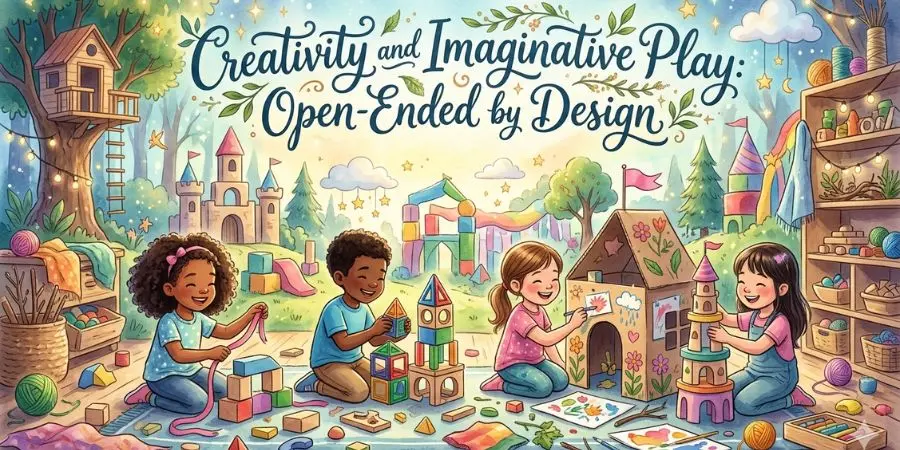
One of the most important things about wooden blocks is what they are not. They are not a kit with instructions. They do not come with a predetermined outcome. There is no “right” way to play with them. This open-endedness is not a limitation — it is precisely the point.
In a world where so many children’s toys are designed to do one specific thing, wooden blocks invite children to decide for themselves what to create. That kind of open-ended play is essential for creative development. Creativity is not just about art; it is about the capacity to approach problems without a fixed solution in mind, to experiment, to revise, and to imagine possibilities that do not yet exist.
Children who play regularly with open-ended materials like wooden blocks tend to develop stronger creative thinking skills than those who primarily play with highly structured, single-purpose toys. They become comfortable with uncertainty. They learn that there are multiple valid solutions to a problem. They develop the confidence to try something new even when the outcome is not guaranteed.
The imaginative dimensions of block play are equally rich. A rectangular block becomes a bed, a car, a phone, a stepping stone, a piece of food, or a spaceship depending entirely on what the child decides in that moment. Wooden Blocks for Kids, This symbolic thinking — the ability to let one thing represent another — is a cognitive milestone that lays the groundwork for reading (letters represent sounds) and mathematics (symbols represent quantities).
Screen-Free, Sensory-Rich, and Developmentally Appropriate
There is a growing body of concern among child development specialists about the amount of screen time young children are exposed to. Wooden blocks offer a compelling, screen-free alternative that engages all the senses simultaneously.
The texture of smooth wood, the satisfying sound of blocks connecting, the visual appeal of natural grain and colour variation, the weight and resistance of solid wood in small hands — these sensory experiences engage children’s nervous systems in ways that a screen simply cannot.
Sensory-rich play supports neurological development, particularly in the early years when the brain is building the foundational connections that will underpin learning for the rest of a child’s life.
There is also something to be said for the pace of block play. It is slow, deliberate, and patient by nature. It does not flash, beep, reward, or demand attention. Children who spend regular time in this kind of calm, focused, self-directed activity develop a different relationship with attention than those who are predominantly exposed to fast-paced digital stimulation. They practise the art of being absorbed in something quiet — a capacity that becomes increasingly rare and increasingly valuable.
The Role of Adults: Knowing When to Step In and When to Step Back
One of the subtler arts of supporting block play is knowing how involved to be. Adults who hover too closely and direct every move can unintentionally rob children of the discovery, problem-solving, and creative ownership that make block play developmentally powerful in the first place.
Wooden Blocks for Kids, At the same time, a completely hands-off approach misses an opportunity. Research on the importance of “serve and return” interactions in early childhood suggests that when adults respond to a child’s play with genuine interest — a question here, a comment there, an occasional suggestion — children’s engagement deepens and their language development accelerates.
The sweet spot is a kind of curious, non-directive presence. Sitting nearby, asking open questions (“I wonder what would happen if you put the bigger piece on the bottom?”), naming what you observe (“you’ve made a really long bridge”), and celebrating effort rather than outcome (“you kept trying even when that part was tricky”) — these small interactions enrich block play without taking it over.
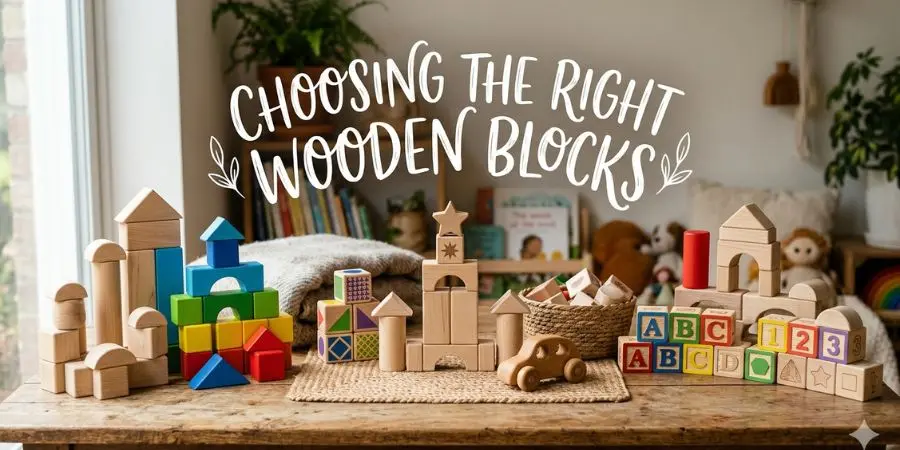
Choosing the Right Wooden Blocks
Not all wooden blocks are equal, and it is worth thinking about what to look for when choosing a set for a young child.
Natural, untreated wood is generally the best choice for very young children, especially those who are still mouthing objects. Look for blocks that are sanded smooth with no sharp edges. Well-crafted sets use hardwood that holds up to years of play without splitting or splintering.
Wooden Blocks for Kids, Variety in shape and size matters. A good set will include not just rectangular prisms but arches, cylinders, triangles, and curved pieces. This variety encourages more complex thinking and more creative construction. Unit blocks — blocks that have mathematically proportional relationships with one another — are particularly valuable because they naturally introduce children to fractions and ratios through play.
A set that can grow with the child is also worth prioritising. Simple, geometric wooden blocks do not have an expiration date. They are as useful for a two-year-old learning to stack as they are for a six-year-old building elaborate structures, and they remain relevant through the primary school years as props for storytelling, model-making, and mathematical exploration.
Final Thoughts
In the rush to find educational advantage for our children — through apps, programs, structured activities, and early academics — it can be easy to overlook the profound learning that happens during something as seemingly simple as stacking wooden blocks on a playroom floor.
But developmental science keeps pointing us back to the same conclusion: young children learn best through play, and open-ended, hands-on, sensory-rich play in particular. Wooden blocks check every one of those boxes.
Wooden Blocks for Kids, They build spatial reasoning and mathematical foundations without a single worksheet. They develop fine motor skills without a single drill. They teach social negotiation without a single lesson plan. They nurture creativity, language, emotional resilience, and logical thinking — all at the same time, all through the simple act of building and imagining and knocking down and starting again.
There is a reason wooden blocks have been in classrooms and homes for over two hundred years. They work. Not because they are high-tech or impressive, but because they meet children exactly where they are and give their developing minds the raw material to grow.
The next time you see a child absorbed in building a tower, resist the urge to ask what it is supposed to be. Watch instead. Watch the concentration in their eyes, the precision in their fingers, the quiet satisfaction when the last piece settles into place. You are witnessing learning in its most natural, most joyful, and most enduring form.
FAQs
At what age can children start playing with wooden blocks?
Children can start as early as 6–12 months with large, simple blocks. As they grow, they handle more complex shapes. By age 3–4, they build elaborate structures independently.
Do wooden blocks really help with math skills?
Yes! Sorting, stacking, and comparing blocks teaches size, quantity, symmetry, and proportion — all foundational math concepts — long before formal numbers are introduced in school.
How are wooden blocks better than plastic toys for development?
Wood offers natural weight, texture, and sensory feedback that plastic lacks. This richness supports motor skills, focus, and neurological development more effectively than lightweight plastic alternatives.
How much daily playtime with blocks is recommended for toddlers?
Even 15–20 minutes of daily block play makes a meaningful difference. Consistency matters more than duration — regular, uninterrupted sessions build the deepest cognitive and creative benefits.
Should parents play alongside children during block play?
es, but lightly. Ask open questions, name what you observe, and celebrate effort. Avoid directing every move — children learn most when they lead and adults gently support from the sideline.

“Hi, I’m Turab Sheikh, the founder of Kids Play Learn. With 2+ years of experience in creating safe and educational toys, I’m passionate about helping children learn, play, and grow in a fun way every day, and I focus on providing toys that inspire creativity, curiosity, and joyful learning.”